Détecteurs semi-conducteurs HPGe et Si(Li)
- Constructeur
- Ortec
- Réf. HTTS
- HTS-NUC-0068
- Réf. HTDS
- DETECTEURS SEMI CONDUCTEURS HPGE ET SILI
- Division
- Nucléaire & Radioprotection
Galerie et schémas techniques


Description
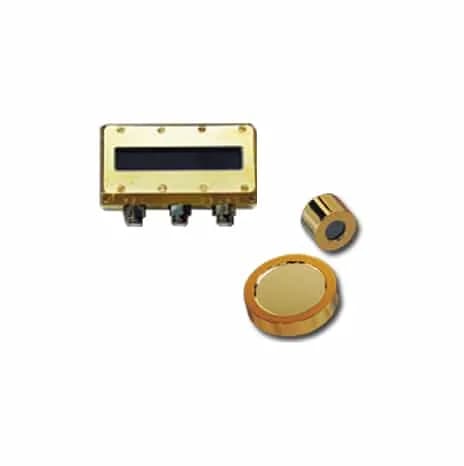
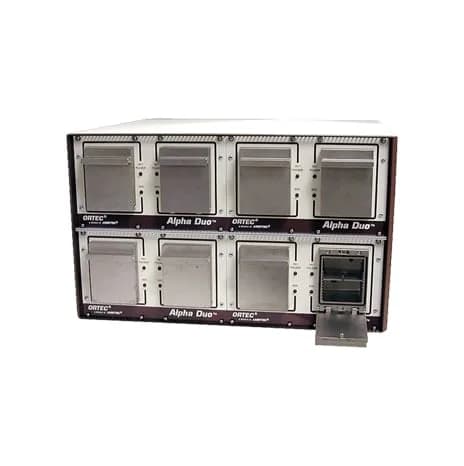
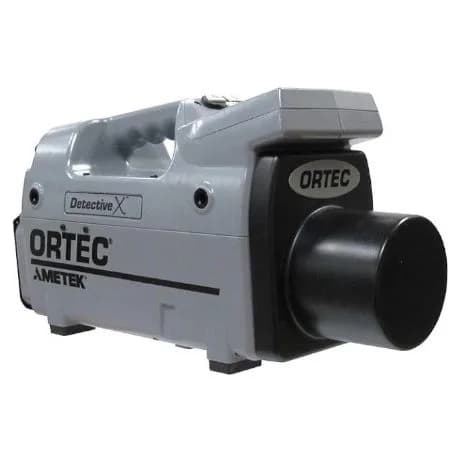
HTDS propose avec ses fournisseurs une large gamme de détecteurs pour la spectroscopie nucléaire : Détecteurs HPGe & Si(Li) pour rayonnement. Ces détecteurs semi-conducteurs permettent de capter des rayonnements Gamma avec une très grande résolution. Il est nécessaire de les refroidir à des températures proche de l’azote liquide pour obtenir leurs meilleures performances. Ils sont généralement utilisés pour la spectrométrie de laboratoire ou portable. Les détecteurs SiLi (famille SLP) sont utilisés pour les basses énergies (1 à 30KeV), quant aux HPGe (Germanium haute pureté) ils sont utilisables de 3keV à 10MeV. Voici les différents détecteurs gamma haute résolution disponibles de la gamme ORTEC : Les détecteurs en stock Liste des détecteurs ORTEC en Stock
Pour détecter vos Gamma de 1eV à plus de 10MeV
Caractéristiques
- Très large choix de détecteurs
- Détecteurs HPGe (type N ou P) ou SiLi
- Large gamme d’énergie de 3Kev à 10MeV
Spécifications techniques
- U
- 25.6* Bi ( U) 727.2
- GEM
- P coaxial
- GLP
- P planaire
- GMX
- N coaxial
- GWL
- P coaxial reverse
- SLP
- Si(Li) planaire
- keV
- Diameter @5.9 keV
- PIXE
- SLP, IGLET, IGLET-X
- Well
- 0.3 Ion 10 keV–10 P-type HPGe Up to 400 2.10–2.30 keV Yes
- ORTEC
- Thickness Energy Standard* Energy Peak to Temperature
- GEM-FX
- Nominal Eff. @122 keV
- GEM-MX
- Nominal Eff. @122 keV
- Planar
- 0.1 1 keV–30 keV Lithium 4–16 mm 160–250 eV Yes
- Window
- Implanted Diameter @5.9 keV
- 214 238
- 208 232
- Coaxial
- 585–720 eV
- PROFILE
- 38%–175% 900–1300 eV
- Pb ( U)
- 46.5 Ac ( Th) 911.0
- Special
- <0.1 <1 keV–>60 P-type HPGe 6–16 mm 135–160 eV Yes
- Type of
- Window Useful Standard* Standard* Standard Peak Shapes Warranted
- Detector
- Geometry (μm) Range Material Sizes Resolutions Compton FW.1M/FWHM FW.02M/FWHM Cyclable
- Diameter
- @5.9 keV
- Tl ( Tl)
- 583.1 Bi ( U) 1764.5
- U x-rays
- 13.0, 13.3* Cs 661.6
- Implanted
- Diameter @5.9 keV
- PROFILE C
- P coaxial
- 235U, 226Ra
- 185.7, 186.2 214Bi (238U) 1120.3
- Application
- Most Suitable Detector(s)
- Short Thin-
- 0.3 Ion 3 keV–1 MeV N-type HPGe 36–70 mm 300–495 eV Yes
- Waste assay
- Micro-trans-SPEC, trans-SPEC-DX-100T, GEM, GMX
- 214Pb (238U)
- 351.9 60Co 1332.5
- 234Th (238U)
- 63.3 228Ac (232Th) 969.0
- 212Pb (232Th)
- 238.6 60Co 1173.0
- PROFILE GEM F
- P semi-plan
- PROFILE GEM M
- P coaxial
- PROFILE GEM S
- P semi-plan
- CSS Advantages
- For a given HPGe detector, a CSS will always reduce Compton
- PROFILE GEM SP
- P semi-plan
- Lung monitoring
- Actinide-85
- CSS Disadvantages
- The sample size is usually small because the sample must be
- I = I0e–μ(E) X
- (2)
- Cryostat Materials
- Fig. 18. View of GAMMASPHERE with Right Half Removed.
- Coaxial 700 (sides)
- MeV Diameter @14.4 keV
- Detector Efficiency
- ε(E)
- 10. See, for example
- R. Keyser, T. Twomey, S. Haywood, W. E. Parker, T.F. Wang, D. Clark, K. Raschke, W.Romine, W. Buckley and
- Famille de détécteur
- Type
- Freight/Border Security
- Micro-Detective, Detective-EX, Detective-DX, IDM
- The Analyzable Spectrum
- Good Data vs. BAD Data
- Drifted Silicon Diameter
- @5.9 keV
- Post-accident monitoring
- GEM (PLUS option recommended)
- choice of configurations.
- 137
- Neutron activation analysis
- GMX (PLUS option recommended)
- Small environmental samples
- GWL (low-background recommended)
- High-grade fissile materials
- SGD, SGD-GEM
- Sea or airborne surveillance
- Micro-trans-SPEC, trans-SPEC-DX-100T, IDM
- Détecteur spécial Safeguard GEM
- P coaxial
- In-Situ environmental spectroscopy
- Micro-trans-SPEC, trans-SPEC-DX-100T, GEM, GMX
- MDA (E) ~ SQRT [R (E) B (E)]/ε(E)
- (1)
- Compton-suppressed gamma spectroscopy
- GMX, GEM (based on range of energy interest)
- If the answer is no, consider this next
- Will the count rates of the 231 214 238
- specified energy. ε(E) will depend on the
- Figure 7. Point source efficiency curves for planar
- Large environmental samples with complex spectra
- GEM, GEM-F, GEM-M, GEM-MX, GMX, (low-background recommended)
- placed inside the NaI annulus. The system is complex
- coincidence electronics require
- GMX however would cost significantly more, and for the
- P-type (GEM). (Point source at 25 cm.)
- human lung measurements, a high contributor to Compton
- 137 241
- Synchrotron light studies; Soft x-ray (fusion) research
- IGLET, IGLET-X, SLP, GLP
- Because both detectors greatly exceed the diameter of the
- point source geometry.
- person’s bones. This cannot be reduced by the detector.
- ratio, improving MDA.
- where the quantity of sample is very small, e.g., in some
- Figure 13. Disk and “wrap-around’ geometries compared.
- PROFILE GEM-MX can provide good efficiency for 241Am). The
- Figure 9. Comparison of absolute efficiency of an N-type (GMX) and a
- the 120% are almost 3 times as large as those from the 12%
- Figure 16. 12% uncollimated and 120% collimated detectors compared at the
- background is the natural 40K gamma rays scattering from the
- relative efficiency GMX detectors, showing the effect of increasing P:C
- presented to the detector, this will also add to the general
- detectors.
- (Ref. 3)? Yes and no! More efficiency will always improve the
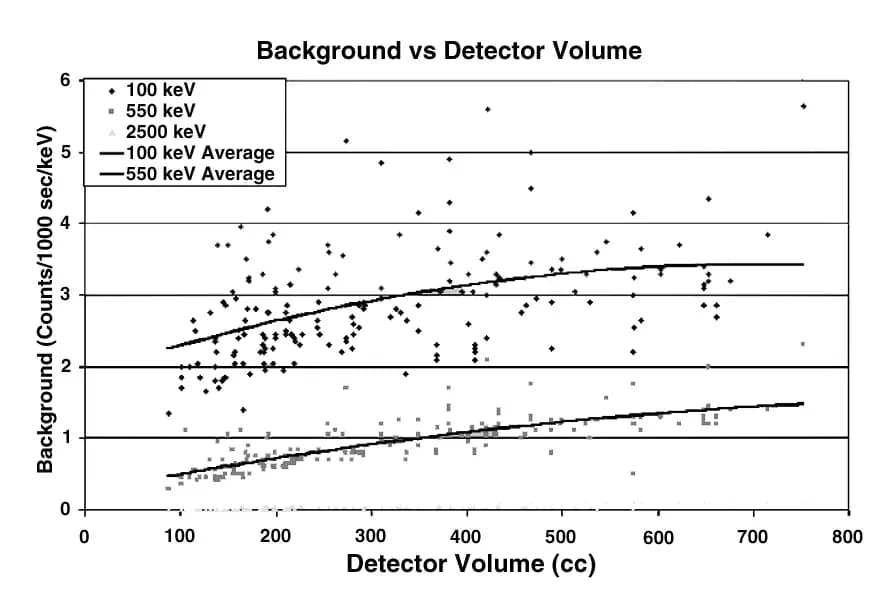
- Figure 3. Background counts vs. detector volume for a large number of
- example of the reduction in background count rate that can be
- 234Th (238U) 92.6 234mPa (238U) 1001.0
- lower the MDA, but the same amount of investment in a higher-
- Cosmic 511.0 40K 1460.8
- present. As soon as a sample source with non-zero activity is
- Figure 4. Peak to Compton ratio vs. relative efficiency for coaxial P-type
- background counts created by the radioactive isotopes that are
- Cs 31.8, 32.2, 36.4* Pa ( U) 766.6
- the sample as if it is on the face of the endcap. However, when
- Figure 12. 1 L and 2 L Marinelli Beakers compared to 1 L bottle on endcap
- you consider gamma rays emitted at an angle, the curved surface
- for a GMX detector.
- efficiency detector will produce about the same MDA improvement.
- 208 232 214 238
- lines at energies above 1500 keV, a low-background cryostat is of
- * The lines lower than 46 keV are reported only for LO-AX and GMX detectors.
- Closed-End 700 40 keV–10 P-type HPGe 10%–150% 175–240 keV 37
- 1–90:1 1.90–2.00 2.65–3.10 Yes
- Closed-End 700 40 keV–10 P-type HPGe 59–90 mm 675–1300 eV 40
- 1–90:1 1.90–2.00 2.65–3.10 Yes
- If the answer is yes, then a Low- or Extra-Low-background detector
- Isotope Energy Isotope Energy
- beaker. However, and it is important, if there is enough sample to
- Figure 11. Comparison of 1 L and 2 L Marinelli beakers on the same detector.
- detection limit reached in a given count time. However, you should
- detectors.
- is needed to achieve detection limits. It can be provided in a wide
- (Parent Nuclide) in keV (Parent Nuclide) in keV
- the reset of the preamplifier (if not resistive), defines the system
- Figure 15. System throughput curves.
- 1500 keV, and little better above that. If your peaks of interest are
- 214Pb (238U) 295.2 214Bi (238U) 1238.0
- detector will produce the best possible results.) For measurements of
- Bi ( U) 609.3 Tl ( Tl) 2614.5
- present at low levels in a standard cryostat?* If the answer to this 210
- 238 228 232
- Closed-End <15 (face) 10 keV–10 P-type HPGe 59–94 mm 800–1280 eV 62
- 1–90:1 Yes
- Closed-End <15 (face) 10 keV–3 MeV P-type HPGe 58–85 mm 485–600 eV 35
- 1–55:1 Yes
- Thin Window 0.3 Ion 3 keV–10 MeV N-type HPGe 10%–100% 1.90–2.65 keV 38
- 1–64:1 1.90–2.30 2.65–3.30 Yes
Applications
- Spectrométrie nucleaire
- Sécurité du territoire
- Médecine
Conformités et normes
Fiche produit HTTSystems
Téléchargez la fiche technique à nos couleurs et coordonnées, ou consultez-la en plein écran.
Demander un devis
La référence HTS-NUC-0068 est reportée dans votre dossier. Vous complétez le contexte, un ingénieur reprend la suite.
Demander un devisParler à un technicien
Une question d'installation, de consommables ou de compatibilité avant de chiffrer ? Nos ingénieurs vous répondent depuis Douala.
Poser la questionÀ rapprocher de cette fiche
Même famille, ou à défaut même division.